

Wisconsin families fight to bring WWII heroes home 80 years later

80 years later, Wisconsin families fight to bring WWII heroes home
Two Milwaukee-area families – connected by Marine pilot Walter Eck and gunner Irvin Korotki – only recently learned their loved ones served and died together in World War II.
MILWAUKEE - The journey of two Milwaukee-area families, who only recently discovered their shared connection. And the bold attempt – happening this week on the other side of the world – to finally bring their lost heroes home.
Remembering the forgotten
What they're saying:
How do we honor those who serve and sacrifice?
"It seems like," said Bob Litkowiec of Cudahy. "They died and they’re just forgotten."
As the years goes by, how do we keep our heroes’ stories alive?
"We, as a country," said Bruce Bailey of Greenfield. "Have to bring them home."
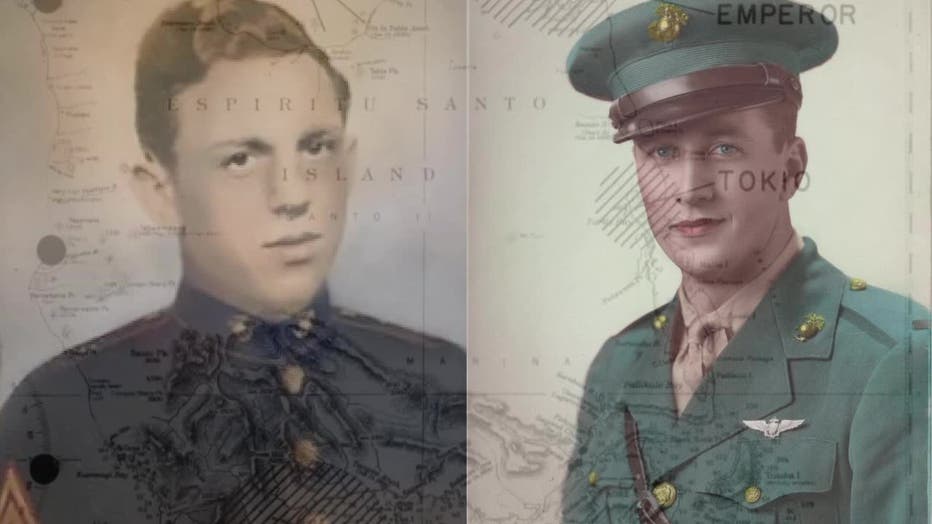
Photos, medals and fleeting memories are all Litkowiec has of his older brother, PFC Irvin Korotki.

"My mother made it for me," Litkowiec said, looking at a uniformed photo from his childhood. "She says, 'That’s a Marine uniform, like your brother.'"
FREE DOWNLOAD: Get breaking news alerts in the FOX LOCAL Mobile app for iOS or Android
Photos, medals and his grandmother’s stories are all Bailey has of his uncle, 1st Lt. Walter Eck.

"She always displayed the Gold Star mother logo in the window," Bailey, who was very close to his grandma, recalled. "I remember that all the time."
Two Marines, one mission
What we know:
Two men living parallel lives. Unaware of the shared pain and questions their families carried for 80 years.
Marine pilot Walter Eck, a graduate of Milwaukee’s Pulaski High School, flew an SBD-4 Dauntless dive bomber during World War II. He completed more than 40 bombing raids and is credited with sinking four Japanese ships.
His gunner – flying backwards on the harrowing missions – was Irvin Korotki of Cudahy.
"'At one time, mysteriously, we ended up with a case of beer,'" said Litkowiec, reading from a book written by a fellow Dauntless pilot. "'Walter Eck’s gunner – that’s my brother – gave it to Walt with no question asked.'"

By 1943, their squadron was stationed on the island of Espiritu Santo, in what is now the country of Vanuatu.
"They were in constant fighting on Guadalcanal," Bailey said, remembering letters Eck sent home to Bailey's grandmother. "Now they’re going to get pulled back to another island that’s a little safer. Well, then two weeks later, he was dead."
U.S. military records show the pair was on a training flight when their Dauntless, "Failed to pull out of a dive and crashed."
"She got the telegram, 'Missing in Action,' " Litkowiec said of his mother. "She thought, well maybe he’ll come back."
Decades of unanswered questions
Dig deeper:
But more than 80 years later, they are still not back. Their bodies were buried near the crash site, lost to time and the encroaching jungle.
"Both of them are laying in the jungle somewhere," said Litkowiec. "Middle of nowhere. And it bothers me."
Until, perhaps, now.
"Anytime you do one of these, it's such a rollercoaster," stated Jed Henry, the Founder and President of the PFC Lawrence Gordon Foundation, a non-profit dedicated to finding, identifying and honoring missing soldiers — mainly from World War II.
"We honor these guys by trying," said Henry over Zoom. "And that's the idea behind it all."
It took years, but after Litkowiec reached out for help, Henry was able to put together some of the missing pieces. Like the fact that the pilot’s family lived a mere ten miles away.
"So you got two Marines, from Milwaukee," Bailey said. "Who have never been returned to the [United] States."
Declassified documents show there was a follow-up search in 1947. But the remains were never found, deemed, "Non-recoverable."

The commander noted, "The plane could have been within ten feet" of the search team without being detected, "Due to the thick foliage."
And yet, here we are. As of last week, Henry and his team of volunteers were on the island -- hopeful they can actually find two needles in a haystack of South Pacific jungle.
"We had two approaches," Henry said after starting their search. "No. 1 was get out and find as many locals, because someone probably knows where it is."
And No. 2 – technology. LiDAR – or, Light Detection and Ranging – uses laser pulses from an aerial drone to scan the surface.
"They can put it into a computer model," explained Henry. "And essentially wipe away the vegetation, so you can see what's on the ground."

Be it the remains of an airplane, or even the crater of a crash site.
Holding on to hope
What they're saying:
"No one has been here since 1947 and looked for these guys," said Henry. "And the fact that someone set foot on the island and cared enough about his brother, I think that means something to [Bob]."
Back in Milwaukee, it most certainly does.

"It makes me feel good," Litkowiec said. "That somebody is interested in going to this extreme."
SIGN UP TODAY: Get daily headlines, breaking news emails from FOX6 News
It means something to Litkowiec and to Bailey. Two men longing to bring their family home.
"It means something," Bailey echoed, speaking about his uncle. "That he be buried along with other fallen heroes."
As time moves on and memories fade, what do we owe those who served and sacrificed?
In a word, everything.
"We have to do everything we can to remember him," stated Bailey. "And it’s part of that, our country can’t forget our fallen people.
Epilogue
Why you should care:
Ultimately, Henry's team did not find anything during their week on the island from either the LiDAR scans or at the four different sites where locals reported finding human remains.
But that does not mean the search is over. The South Pacific WWII Museum on the island will continue pursuing leads.
And for the families back home, they know this — the story of these missing Marines is very much alive.
The Source: The information in this post was collected and produced by FOX6 News.