

Change the weather? Inside America’s hurricane experiment
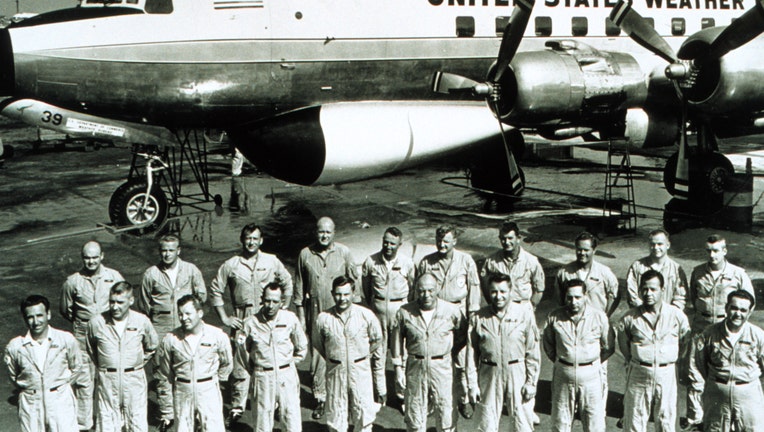
A 1966 photo of the crew and personnel of Project STORMFURY, an experimental program by the US Government to weaken tropical cyclones using silver iodide. Credit: NOAA
A U.S. Air Force B-17 bomber left the runway and headed directly into the path of a hurricane that was more than 400 miles east of Jacksonville on Oct. 13, 1947.
The mission? Dropping crushed dry ice into the storm. The goal? Find out if humans could control a hurricane. Officials from the National Oceanic and Atmospheric Association called it the "first attempt to modify a tropical cyclone." It was almost the last.
FREE DOWNLOAD: Get breaking news alerts in the FOX LOCAL Mobile app for iOS or Android
Project Cirrus
The backstory:
The flight into the hurricane was all a part of Project Cirrus, which was a collaboration between General Electric Laboratories, the U.S. Navy and the Army Signal Corps.
The idea came from a scientist at GE named Vincent Schaefer, who discovered that sprinkling dry ice into super-cooled water could trigger freezing. That gave hurricane researchers an idea. They hoped that seeding clouds in a hurricane might cause the storm to weaken.
On Oct. 13, 1947, they released about 180 pounds of dry ice into the storm’s outer clouds. Within a day, the hurricane unexpectedly made a huge turn to the west and slammed into Georgia and South Carolina.
The storm killed one person and caused $2 million in damage.
SIGN UP TODAY: Get daily headlines, breaking news emails from FOX6 News
At the time, GE scientists said they were "99 percent sure" the seeding had changed the storm’s course. Not surprisingly, public outrage followed. Further investigations later showed that hurricanes can and do shift direction suddenly as a part of their natural development. However, the backlash ended hurricane-modification research for more than a decade.
From Cirrus to STORMFURY
What's next:
By the late 1950s, a series of damaging hurricane seasons led Congress to fund the National Hurricane Research Project. Among its goals was improving forecasts and, once again, exploring whether hurricanes could be altered.
That idea became Project STORMFURY, which launched in 1962 under the U.S. Weather Bureau and the Department of Defense. This time, researchers were hoping to weaken hurricanes by seeding them with silver iodide, which is a compound that could freeze super-cooled water in the atmosphere and possibly disrupt the hurricane's structure.
The hypothesis was that forcing the storm to form a new eye wall could reduce wind speeds by up to 30% – even a small drop in wind speed might spare lives and property.
Only a handful of storms met the strict safety criteria: at least 100 miles offshore and unlikely to reach land within 24 hours. The first apparent success came with Hurricane Beulah in 1963, when wind speeds dropped nearly 20%. The most promising results came from Hurricane Debbie in 1969, which appeared to weaken after two seeding flights.
By the 1970s, scientists had learned that hurricanes contained far less supercooled water than they expected, which meant their seeding attempts likely weren't as impactful as they seemed.
Research proved that tropical systems can weaken and reorganize naturally without any outside intervention. So, what had looked like human influence was, in most cases, the storm’s own behavior.
It also became clear that proving any effect would require hundreds of controlled tests which, even today, would be impossible to do safely and consistently. In 1983, Project STORMFURY officially ended.
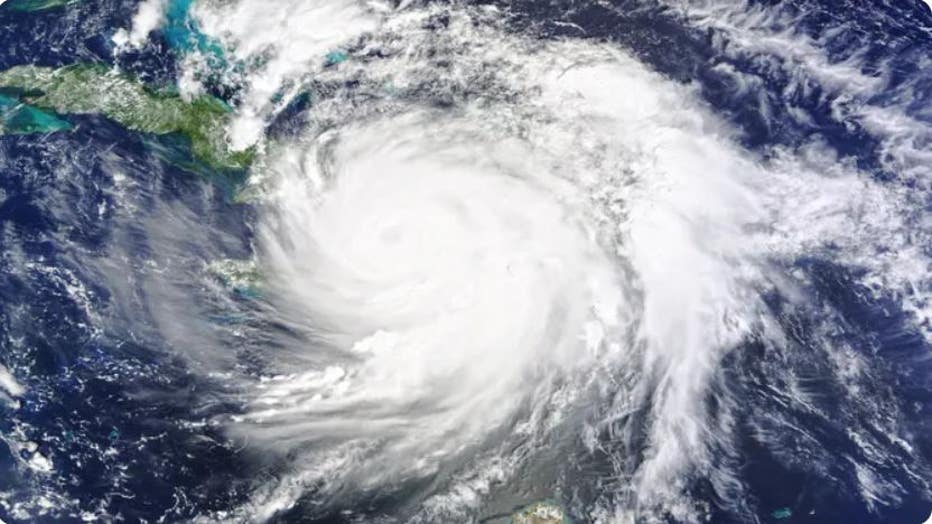
On Oct. 4, 2016, Hurricane Matthew made landfall on southwestern Haiti as a Category 4 storm – the strongest hurricane to hit the Caribbean nation in more than 50 years. Just hours after landfall, the Moderate Resolution Imaging Spectroradiometer (MO
Hurricane modification research
Timeline:
- 1947: First hurricane seeding, Project Cirrus
- 1962–1983: Project STORMFURY conducted (4 hurricanes seeded, 8 total flights)
- 1983: Program ended, focus shifted to forecasting and safety
Legacy and lessons
Big picture view:
Although it failed to control hurricanes, Project Cirrus and later, STORMFURY, helped to reshape modern storm research. It advanced aircraft instrumentation, numerical modeling and our understanding of hurricane dynamics.
The project also laid the foundation for today’s NOAA Hurricane Research Division and its fleet of "Hurricane Hunter" aircraft.
So, while the goal of weakening hurricanes was not achieved, the effort led to a broader understanding and advanced tropical storm science.
Today, scientists focus on forecasting accuracy, coastal preparedness and building resilience rather than storm manipulation.
The Source: FOX6 Weather Experts referenced information from the NOAA Atlantic Oceanographic and Meteorological Laboratory; Bulletin of the American Meteorological Society; Monthly Weather Review (1957); Emily Senesac, NOAA Photo Library (2024).