

Annual report ranks the worst cities for drivers in 2025

New study finds driving while listening to heavy metal music causes drivers to be more erratic
The research was conducted by Auto Express Magazine and road safety charity IAM RoadSmart, and it analyzed how motorists would react to four different genres of music: metal, classical, rap and pop.
Most Americans rely on cars to get around, but some cities are better – or worse – for those behind the wheel, according to a new study.
WalletHub compared the 100 largest cities across 30 key indicators of driver-friendliness. The data set ranged from average gas prices to annual hours in traffic congestion to auto-repair shops per capita.
What they're saying:
"Car prices have gone up significantly over the past few years, and gas remains expensive going into the summer travel season. Living in one of the best cities to drive in can make owning and maintaining a car much cheaper," Chip Lupo, a WalletHub analyst, said. "However, costs aren’t the only factors that matter; the best cities for drivers also minimize commute times and traffic congestion, have accident rates well below the national average and keep their roads in good condition."
Corpus Christi, Texas ranked best city for drivers
By the numbers:
According to the data, Corpus Christi, Texas, was ranked the best city to drive in, due in part to its low costs.
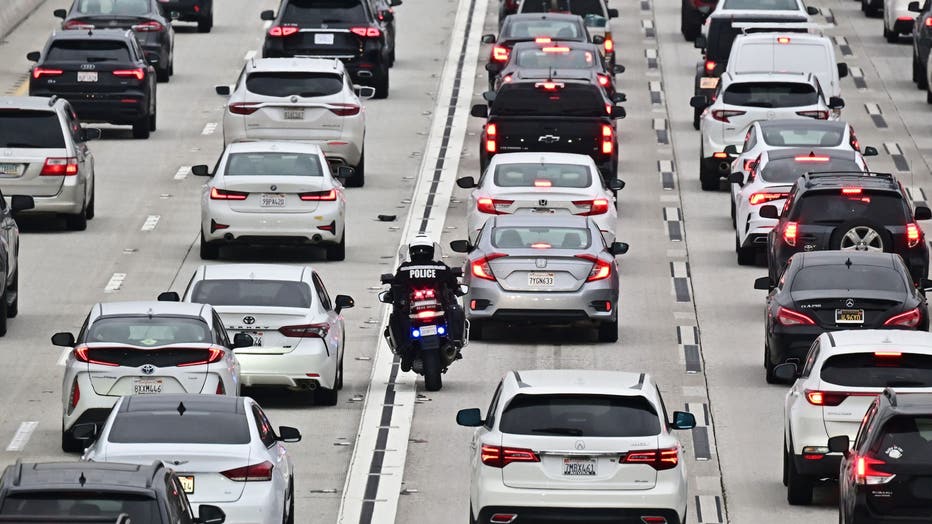
A motorcycle officer weaves through traffic on a Los Angeles freeway during the evening rush hour on April 12, 2023 in Los Angeles, California. (Credit: Frederic J. BROWN / AFP via Getty Images)
It was the third-cheapest city for gas and tied for seventh-cheapest for purchasing a new vehicle. It was also the 11th-least expensive city when it came to additional vehicle operating costs like lost time and fuel waste due to traffic congestion, or damage from poorly-maintained roads.
RELATED: These US states have the worst-behaved drivers: See where your state ranks
In addition, Corpus Christi had the best-maintained bridges in the country and ranked 25th out of the 100 cities in the study when it came to road quality. Residents also enjoy the fourth-lowest average commute times and second-lowest hours spent in congested traffic per year.
Finally, Corpus Christi shined when it came to safety. It has the highest percentage of adults who always or nearly always wear a seatbelt, at nearly 99%.
This ranking was followed by Greensboro, North Carolina and Boise, Idaho.
Best cities for drivers
- Corpus Christi, Texas
- Greensboro, North Carolina
- Boise, Idaho
- Scottsdale, Arizona
- Laredo, Texas
- Lubbock, Texas
- Birmingham, Alabama
- Plano, Texas
- Austin, Texas
- Winston-Salem, North Carolina
Worst cities for drivers
- Philadelphia, Pennsylvania
- Oakland, California
- Washington, DC
- New York, New York
- Chicago, Illinois
- San Francisco, California
- Detroit, Michigan
- Los Angeles, California
- San Jose, California
- Baltimore, Maryland
See the full report here.
Drivers spend average of 369 hours in car annually
Big picture view:
According to the report, drivers annually spend an average of more than 369 hours on the road. That’s 15.4 days.
Road quality is another big factor in how pleasant one’s driving experience is. America’s highways and bridges are underfunded overall, with a backlog of hundreds of billions of dollars in repairs needed, according to the American Society of Civil Engineers.
The World Economic Forum ranks U.S. roads at 17th in quality out of 141 economically developed nations, too.
RELATED: Annual report lists the most dangerous cities for driving in the U.S.
In June, Allstate came out with its annual "2025 America’s Best Drivers Report" and part of it includes the list of the most dangerous cities for drivers.
The study found that the riskiest states for drivers included Boston, Massachusetts; Baltimore, Maryland; Washington, DC; Worcester, Massachusetts; Springfield, Massachusetts and Glendale, California.
Then last year, researchers determined which U.S. states had the worst-behaved drivers. Forbes Advisor analyzed 19 "bad" driving behaviors to determine how common they were in certain states. The worst-behaved drivers were in Hawaii, Oregon, New Mexico, Wyoming and Alaska.
The Source: In order to determine the best and worst cities for drivers, WalletHub compared a sample of the 100 most populated U.S. cities across four key dimensions: 1) Cost of Ownership & Maintenance, 2) Traffic & Infrastructure, 3) Safety and 4) Access to Vehicles & Maintenance. This story was reported from Los Angeles. Previous FOX Local reporting contributed.