

Full Buck Moon arrives overnight into Wednesday morning
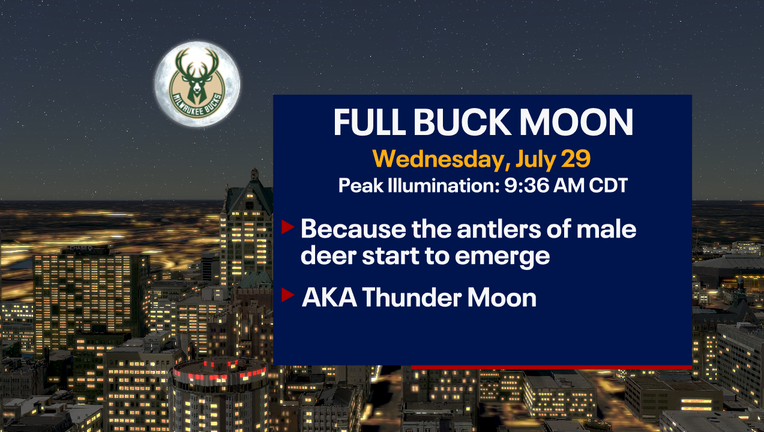
MILWAUKEE - As the sun sets on Tuesday, July 28, skywatchers across Milwaukee and southeast Wisconsin will have the opportunity to witness one of summer's most recognizable celestial events—the Full Buck Moon.
What is a Buck Moon?
What we know:
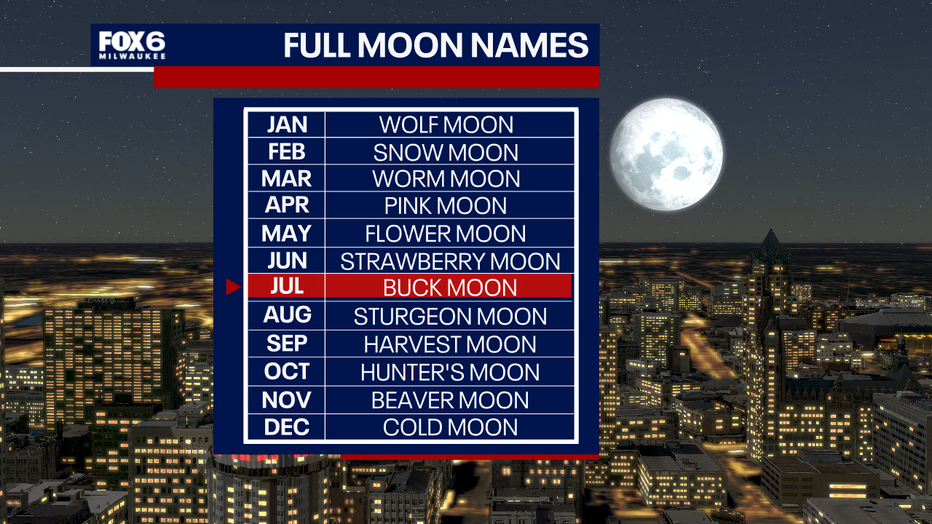
The Buck Moon is the traditional name given to July's full moon because this is the time of year when male deer, known as bucks, begin growing a new set of antlers. The name has been used for generations by Indigenous communities and was later adopted into the traditional Farmer's Almanac naming system. Other July names include the Thunder Moon, recognizing the frequent summer thunderstorms, and the Hay Moon, marking the hay harvest season.
FREE DOWNLOAD: Get breaking news alerts in the FOX LOCAL Mobile app for iOS or Android
It has a peak illumination on Wednesday, July 29, at 9:36 a.m. CDT. The best time to watch would be shortly after sunset as it rises in the night sky.
Moon information
Big picture view:
A full Moon occurs when the Moon is positioned on the opposite side of Earth from the Sun. As a result, the entire Earth-facing side of the Moon is illuminated by sunlight, creating the bright, circular appearance we see in the night sky.
Although the Moon appears to glow on its own, it is actually reflecting sunlight. In fact, the Moon reflects only about 12% of the sunlight that strikes its surface, yet it remains the brightest object in the night sky after the Sun.
If you catch the Moon shortly after moonrise in eastern Wisconsin, it may appear exceptionally large near the horizon. This isn't because the Moon is physically closer to Earth.
SIGN UP TODAY: Get daily headlines, breaking news emails from FOX6 News
Instead, you're experiencing the Moon Illusion—an optical illusion that causes our brains to perceive the Moon as larger when it's viewed alongside familiar objects like trees, buildings, or the Milwaukee skyline. Once the Moon climbs higher into the sky, it will appear noticeably smaller despite remaining virtually the same size.
On another note, the Full Buck Moon marks the midpoint of astronomical summer and serves as another reminder of how predictable the motions of our solar system truly are. While our daily weather can change quickly, the Moon continues its steady 29.5-day cycle through its familiar phases.
The Source: This information is from the FOX 6 Weather Experts and The Old Farmers Almanac.