

Peshtigo Fire, deadliest US history, happened 155 years ago
MILWAUKEE - The Peshtigo Fire, the deadliest wildfire in U.S. history, tore through northeast Wisconsin 155 years ago Thursday, Oct. 8.
On this day
What we know:
There were two historic fires on Oct. 8, 18971. Most will recall it as the day of the Great Chicago Fire, which stole headlines from the Wisconsin blaze that has been described as Hell on Earth.
FREE DOWNLOAD: Get breaking news alerts in the FOX LOCAL Mobile app for iOS or Android
The Peshtigo Fire remains the deadliest wildfire in U.S. history, yet very few outside Wisconsin know about it. Chicago got a myth. Peshtigo got a tragedy.
(Courtesy: Wisconsin Historical Society)
Perfect storm for disaster
The backstory:
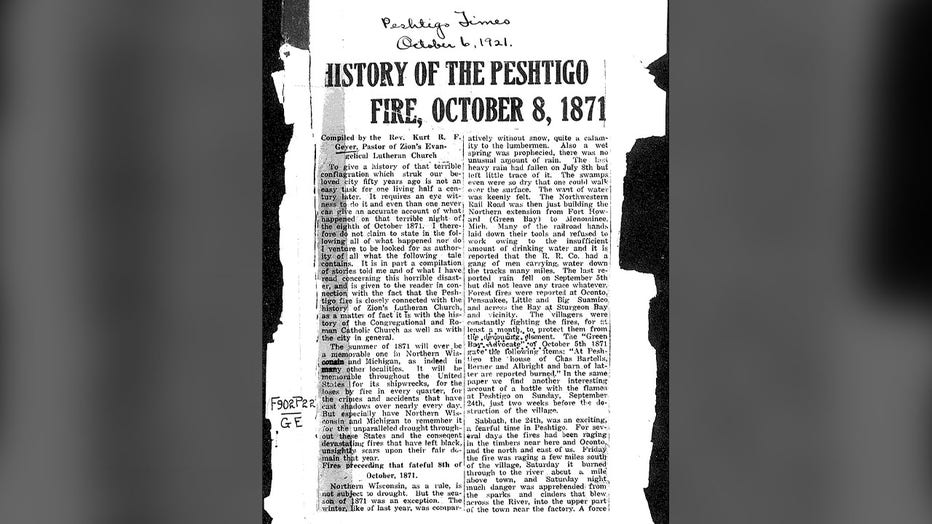
In 1871, slash-and-burn farming and railroad clearing were routine across Wisconsin’s forests. After a summer of drought, the land was a tinderbox. As the Peshtigo Times noted in a 1921 retrospective: "Northern Wisconsin, as a rule, is not subject to drought. But the season of 1871 was an exception."
That night, an eastward-moving cold front kicked up incredibly strong winds. Several small brush fires merged into one monstrous blaze creating a firestorm. Flames were estimated to have reached 2,000 degrees Fahrenheit, and wind gusts reportedly estimated at more than 100 mph kept them roaring.
SIGN UP TODAY: Get daily headlines, breaking news emails from FOX6 News
In early October, small fires had already threatened the area. The Green Bay Advocate reported a barn and house had been burned in Peshitgo three days before the disaster. Area residents were becoming apprehensive as sparks and cinders were observed blowing across the river, into town. By the next night, the area went from fire danger to what many called the apocalypse.
Witnesses were quoted as saying the fire "moved like a tornado," consuming oxygen so quickly that people running for safety simply burst into flames. Many in the fire's path tried to seek safety in the Peshtigo River, but that led to drowning and many succumbed to hypothermia in the cold river water.
The Peshtigo Fire finally ended when the wind died down and heavy, drenching rains came a few hours later – extinguishing the flames.

(Original Caption) 1871-Peshtigo, WI: An illustration of The Great Fire of Peshtigo in Wisconsin. People are shown trying to run and flee the fire in a chaotic scene.
Peshtigo Fire
By the numbers:
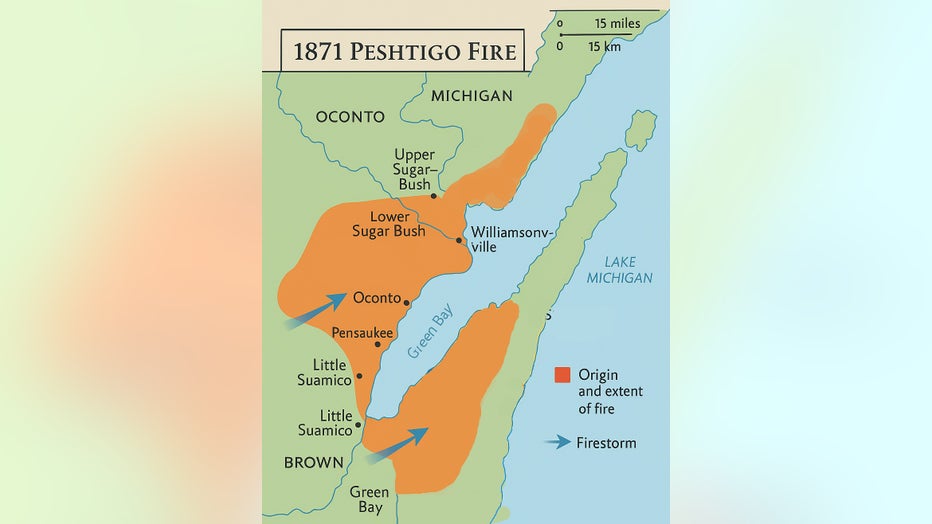
The Pehstigo Fire killed more than 1,200 people and consumed up to 1.5 million acres.
- Area burned: 1.2 to 1.5 million acres
- Communities destroyed: 16 (including Peshtigo, Williamsonville, and parts of Door and Kewaunee counties)
- Estimated death toll: 1,200 to 2,400 people
- In Peshtigo alone: About 800 lives lost
- Temperature of flames: Up to 2,000°F (estimate)
- Wind speeds: More than 100 mph
- Property damage: $5 million (at the time)
- Duration: Roughly one night, Peshtigo was gone in less than an hour
Did a comet spark the blaze?
What we don't know:
Probably not, but there are some that speculate a comet started the fires that led to the Peshtigo blaze as well as the Great Chicago Fire of 1871 and blazes in parts of Michigan and Illinois.
The theory suggests the fires were caused by fragments of Biela’s Comet. Some point to reports of blue flames as evidence of comet material in the fires. Scientists later debunked that as burning carbon monoxide from oxygen-starved air.
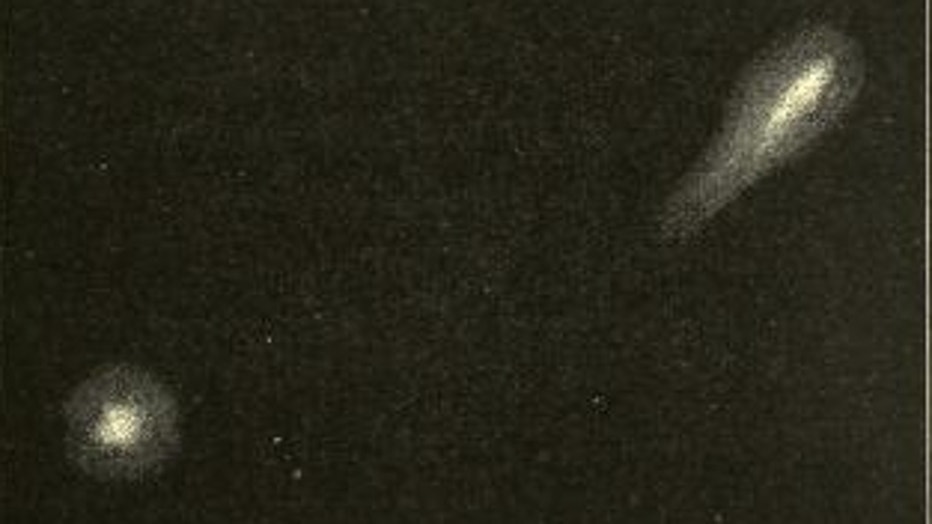
Illustration of Biela's Comet from World of Comets, A. Guillemin, 1877 (U.S. edition) PUBLIC DOMAIN
Legacy of forgotten fire
Why you should care:
After the fire, the lumber industry changed very little, and Wisconsin continued to see major fires for decades. U.S. and British military scientists studied what became known as the "Peshtigo paradigm" during World War II to understand how firestorms form.
Today, the Peshtigo Fire Museum on Oconto Street preserves artifacts and survivor stories. A memorial stands by the bridge over the Peshtigo River, and the Fire Cemetery is listed on the National Register of Historic Places.
And yet, more than 150 years later, outside of Wisconsin, the story is still barely a footnote. So the next time someone mentions Mrs. O’Leary’s cow, you can smile and say, "Sure, but have you heard about Peshtigo?"
The Source: Information in this story is from the FOX6 Weather Experts, Wisconsin Historical Society, National Weather Service, U.S. National Park Service, and prior coverage of the Pehstigo Fire.