

Astronomers discover rare evidence of 2 planets colliding, study shows
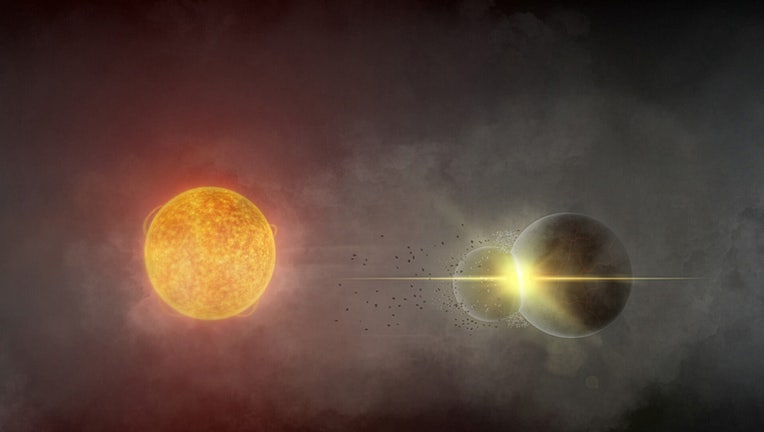
FILE - Lead author Andy Tzanidakis’ rendering of the planetary collision he suspects occurred around star Gaia20ehk in 2021. (Photo: Andy Tzanidakis)
An astronomer from the University of Washington discovered possible evidence of two planets colliding while observing old data on a star thousands of light years away from Earth.
An analysis published in The Astrophysical Journal Letters on March 11 detailed how lead author, Anastasios (Andy) Tzanidakis, found evidence of this rare celestial incident after "combing through old telescope data from 2020."
Distant flickering star
Dig deeper:
Tzanidakis found data from 2020 about a star that was about 11,000 light years away from Earth.
The star, named Gaia20ehk, was a typical "main sequence" star, not unlike our own sun, according to a University of Washington news release.
This means the star’s light should emit a relatively steady stream.
Timeline:
Before 2016, the light was "nice and flat," Tzanidakis said.
In 2021, the star had begun to flicker even more wildly than ever, he said.
What they're saying:
"It went completely bonkers," Tzanidakis added. "I can’t emphasize enough that stars like our sun don’t do that. So when we saw this one, we were like, ‘Hello, what’s going on here?’"
The cause of the flickering had nothing to do with the star itself, researchers said.
What was actually happening as huge quantities of rocks and dust were passing in front of the star as the material was orbiting the system.
The cause – a catastrophic collision between two planets.
Various telescopes had actually captured the collision in real time, Tzanidakis said.
What's next:
Tzanidakis said it’s important to record and observe events such as this one which so closely reflects the collisions that created the Earth and our moon.
"If we can observe more moments like this elsewhere in the galaxy, it will teach us lots about the formation of our world," he said.
The Source: Information for this article was taken from a news release based on the analysis published to the University of Washington’s website on March 11, 2026. The analysis was also published in The Astrophysical Journal Letters on March 11, 2026. This story was reported from San Jose.